


Orca Slicer top and bottom shells, explained
The top and bottom shells are the solid layers that cap a print, closing off the sparse infill so the surfaces come out flat instead of showing the pattern underneath. They are what makes the top of a part look finished and the bottom sit flat on the plate. Set too few and the infill shows through as a rough, dimpled surface; set too many and you waste plastic and time. You can control them by layer count or by thickness, and getting them right is one of the simplest ways to lift the look of a print.
You will find them in OrcaSlicer’s Strength tab, in the Top/bottom shells section.
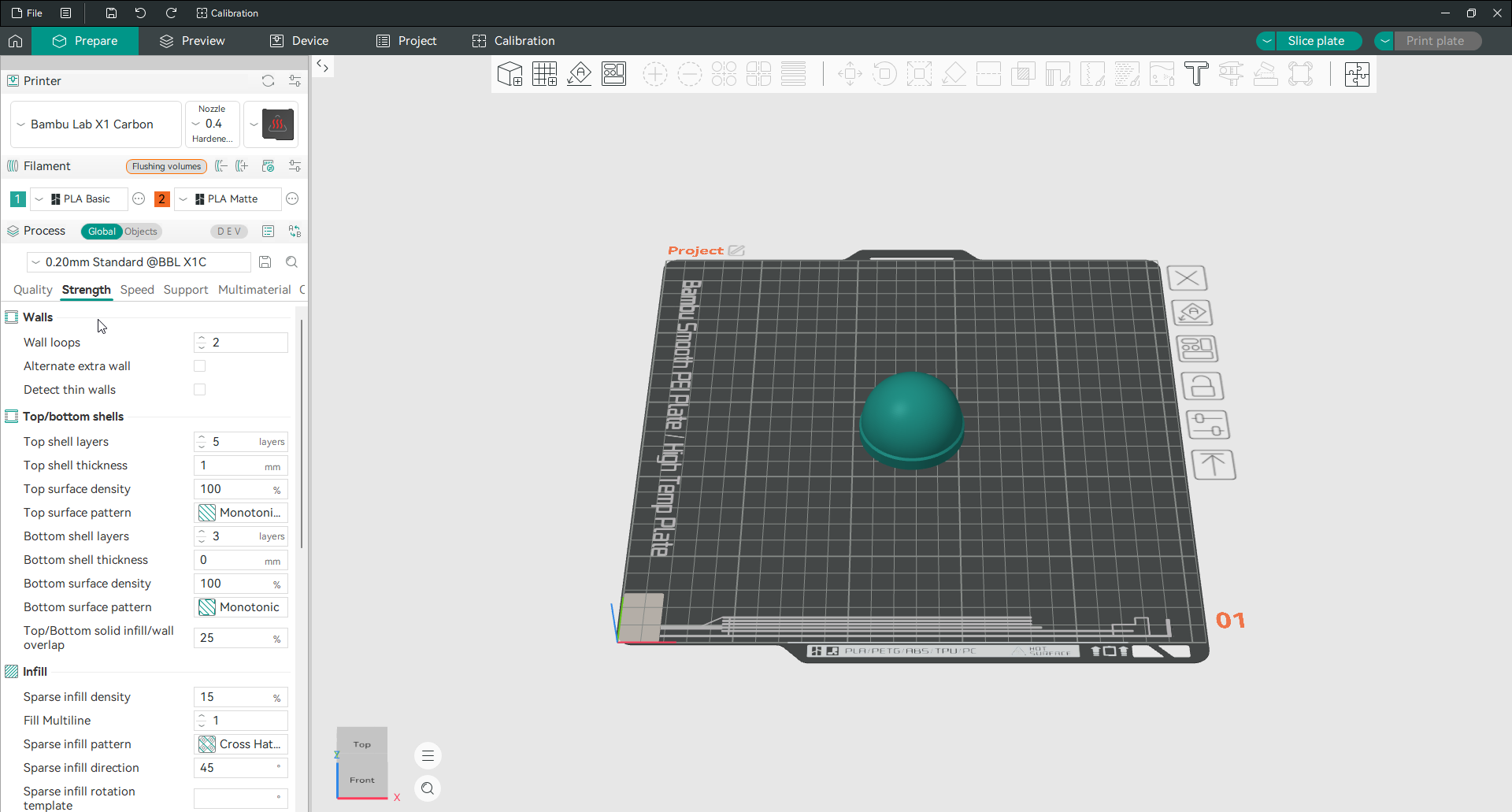
Top and bottom shell layers
These set how many solid layers cap the top and bottom of the print. They are printed over the infill, so more of them means a stronger part and a cleaner surface, up to a point. In Orca Slicer, a common starting point at a 0.2 mm layer height is four or five top layers and three or four bottom layers. If the infill pattern shows through the top as faint dimples, called pillowing, add a top layer or two until it disappears. Bottom layers can usually be fewer than top layers, since the bottom prints against the flat plate.
The reliable rule is to aim for at least 0.8 mm of solid thickness top and bottom. Divide 0.8 by your layer height to get the number of layers you need. At 0.2 mm that is four layers, and at a fine 0.1 mm you need eight to reach the same solid cap.
Shell thickness
The top and bottom shell thickness set a minimum in millimetres, and they work alongside the layer counts. If the layers you chose add up to less than this thickness, the slicer adds solid layers during slicing to reach it. This stops the shell coming out too thin when you print at a small layer height. A value of 0 turns it off, so the shell is decided by the layer count alone. It is a safety net, so you can set a thickness like 0.8 mm and trust the slicer to keep the cap solid whatever layer height you use.
Surface density and pattern
Top and bottom surface density controls how solid those surfaces are, where 100 percent is fully solid. Lowering it leaves a sparse surface, which is only useful for looks, grip, or making an interface, so most prints keep it at 100 percent. The surface pattern sets how the top and bottom lines are drawn, with Monotonic the default because it lays every line in the same direction for an even, clean finish. The pattern applies to the outermost shell layer, while the solid layers beneath it use the internal solid infill pattern.
Solid infill to wall overlap
The top and bottom solid infill to wall overlap slightly enlarges the solid area so it presses into the walls, which bonds the two and stops pinholes appearing where the infill meets the wall. Around 25 to 30 percent is a good starting point. If you see tiny gaps in a ring just inside the walls on the top surface, a little more overlap usually closes them.
Frequently asked questions
How many top and bottom layers should I use?
At a 0.2 mm layer height, four or five top layers and three or four bottom layers suit most prints. The reliable rule is at least 0.8 mm of solid thickness, so divide 0.8 by your layer height to get the count. At 0.1 mm that means eight layers to reach the same cap.
Why does the infill show through my top surface?
That is pillowing, and it means you do not have enough top layers to bridge across the infill before the surface closes. Add a top layer or two until the dimples disappear, and make sure your infill density is not so low that the top layers have too far to span.
What is top shell thickness for?
It sets a minimum thickness for the solid cap in millimetres. If your chosen number of layers adds up to less than that, Orca Slicer adds layers during slicing to reach it. This keeps the shell from coming out too thin at small layer heights, and setting it to 0 lets the layer count decide alone.
Do more top and bottom layers make a part stronger?
Yes, since they are solid and printed over the infill, but with diminishing returns. Extra shells help stiffness and the top surface, while wall count does more for overall strength. Add a couple of shell layers for a better surface, and add walls for load-bearing parts.